A Review on the Role of Multiple Botanicals in Formulating Herbal Powder Shampoo as Eco-Friendly Hair Cleansing Solution
Payal N. Vaja1*, Bhumisha B. Vaja2, Man J. Savaliya3, Meet G. Solanki4,
Farazkhan M. Pathan5, Chetan H. Borkhataria6, Hiral S. Popaniya7
1Assistant Professor, School of Phamacy, Dr. Subhash University, Junagadh (362001), Gujarat, India.
2,3,4,5Research Scholar, School of Pharmacy, Dr. Subhash University, Junagadh (362001), Gujarat, India.
6Assistant Professor. Department of Pharmaceutics,
B.K. Mody Government Pharmacy College, Rajkot (360003), Gujarat, India.
7Assistant Professor, School of Phamacy, Dr. Subhash University, Junagadh (362001), Gujarat, India.
*Corresponding Author E-mail: payalvaja55@gmail.com
ABSTRACT:
Now a day’s demand for the natural shampoo as increased which contains the natural ingredients. Herbal powder shampoo is the best solution for the people who are seeking for the use of natural component shampoo. We can know the difference about the synthetic and natural shampoo and what are the benefits of herbal powder shampoo over the liquid shampoo. This topic helps to know which products are helpful for hair. Herbal powder shampoo is eco-friendly, biodegradable and sustainable solution. People are using the natural shampoo rather than synthetic shampoo, so herbal powder shampoo increased because it contains natural ingredients which are obtained from the plants. This review provide No. of plants use to cure hair issues. It maintains sustainability and it is budget friendly with more benefits.
KEYWORDS: Herbal powder shampoo, Eco-friendly, Herbal liquid shampoo.
INTRODUCTION:
· Hair is a vital part of the human body and requires proper care to remain shiny, smooth, strong, and easy to comb.
· Since ancient times, herbal products have been widely used for cleansing, beautifying, and maintaining healthy hair.
· Nowadays, numerous synthetic shampoos are available in the market. These products primarily contain surfactants to provide cleansing and foaming effects. Over time, synthetic ingredients have gained a significant market share.
· However, people are becoming more aware of the harmful effects these chemicals can have on hair, skin, and eyes. As a result, herbal shampoos, which are derived from natural sources, are being promoted because they are safer, have minimal side effects, and are increasingly in demand by consumers1.
· Hair care products also nourish the hair and help in maintaining a healthy appearance.
· The public's understanding of the negative impacts of synthetic products has led to a noticeable preference for herbal options.
· People now favor herbal products for hair, skin, and eye care because they are generally free from harmful side effects2.
Herbal Shampoo:
Herbal shampoos are cosmetic preparations that have been used since ancient times to cleanse the hair and scalp, beautify the hair, and manage it. They are made with traditional ayurvedic herbs. In addition to being used for cleaning, herbal shampoos are also utilized to give hair a glossy finish and keep it manageable3.
Ideal Properties of Herbal Shampoo2:
· Shampoo should efficiently eliminate dust, dirt, and excess sebum from the Scalp and hair
· It must cleanse the hair thoroughly.
· The formulation should rinse off easily with water without leaving any residue.
· After use, hair should remain soft, shiny, smooth, and manageable.
· It should be gentle on the hands without causing roughness.
· The product must be safe, free from adverse effects, and non-irritating to the Skin and eyes.
· It should spread and distribute uniformly over the scalp and hair.
· The shampoo must generate a rich, stable, and luxurious foam.
· Only a small amount should be sufficient for effective cleaning.
· It should facilitate easy combing of wet hair.
· The formulation should not cause dryness or chapping of the hands.
Types of herbal shampoo4:
· Powder Shampoo
· Liquid Shampoo
· Lotion Shampoo
· Cream Shampoo
· Jelly Shampoo
· Aerosol Shampoo
· Specialized Shampoo
· Conditioning Shampoo
· Anti‐dandruff Shampoo
· Baby Shampoo
· Two Layer Shampoo
Table 1: Difference between Herbal Liquid Shampoo and Powder Shampoo3
|
Herbal Liquid Shampoo |
Herbal Powder Shampoo |
|
1. Liquids are easily contaminated. |
1. Being a powder, it has a lower risk of becoming contaminated. |
|
2. It has a shorter shelf life. |
2. It has a longer shelf life. |
|
3. It might cause skin irritation and discomfort. |
3. It is simple to apply/utilize. |
|
4. It is more likely to be incompatible. |
4. It is less likely to be incompatible. |
|
5. Its stability is poor. |
5. It has greater stability. |
|
6. It is challenging to transport due to the risk of leakage. |
6. It is simple to transport. |
Ideal Composition of Shampoo5:
· Surfactant
· Antidandruff agents
· Conditioning agents
· Pearlescent agents
· Sequestrants
· Thickening agents
· Colours
· perfumes
· preservatives
Benefits of Herbal Powder Shampoo:
· Supports natural hair growth.
· Encourages healthy hair growth.
· Supports the development of strong and fresh roots.
· Eco-friendly and easily biodegradable. Affordable and budget-friendly.
· Enhances natural shine4.
· Animal testing must be completely avoided6.
Table 2: Scientific Classification of Plants
|
Plants |
Kingdom |
Division |
Class |
Order |
Family |
Genus |
Species |
|
Amla7 |
Plantae |
Angiosperm |
Magnoliopsida |
Malpighiales |
Phyllanthaceae |
Phyllanthus |
Phyllanthusemblica |
|
Shikakai8 |
Plantae |
Angiosperms |
Magnoliopsida |
Fabales |
Fabaceae |
Acacia |
Acacia concinna |
|
Henna9 |
Plantae |
Angiosperms |
Magnoliopsida |
Myrtales |
Lythraceae |
Lawsonia |
LawsoniaInermis |
|
Bhringraj10 |
Plantae |
Magnoliophyta |
Magnoliopsida |
Asterales |
Asteraceae |
Eclipta |
Eclipta Prostrata (syn. E. alba) |
|
Tulsi11 |
Plantae |
Magnoliophyta |
Magnoliopsida |
Lamiales |
Lamiaceae |
Ocimum |
Sanctum |
|
Reetha12 |
Plantae |
Magnoliophyta |
Magnoliopsida |
Sapindales |
Sapindaceae |
Sapindus |
Trifoliatus |
|
Hibiscus13 |
Plantae |
Magnoliophyta |
Magnoliopsida |
Malvales |
Malvaceae |
Hibiscus |
Hibiscus rosa-sinensis |
|
Neem14 |
Plantae |
Magnoliophyta |
Magnoliopsida |
Sapindales |
Meliaceae |
Azadirachea |
Azadiracheaindica |
|
Fenugreek15 |
Plantae |
Magnoliophyta |
Magnoliopsida |
Fabales |
Fabaceae |
Trigonella |
Trigonella |
|
Harada16 |
Plantae |
Tracheophyta |
Magnoliopsida |
Myrtales |
Combretaceae |
Terminalia |
Terminalia chebula (Gaertn.) Retz. |
|
Brahmi17 |
Plantae |
Tracheophyta |
Magnoliopsida |
Lamiales |
Scrophulariaceae |
Bacaopa |
B. monnieri |
List of Plants:
1. AMLA
Common Name18,19: Indian Gooseberry/Amla
Biological Source18,19: Phyllanthusemblica Linn. and EmblicaofficinalisGaertn
Family18: Phyllanthaceae
Chemical Constituents18: Emblicanin A and B: Emblicanin A makes up 37% and Emblicanin B makes up 33% of the tannins, Ascorbic acid (Vitamin C): 478.56mg/100mL, Gallic acid: The dried fruit pulp contains 1.32% gallic acid, Proteins: The fruit pulp contains 0.5% protein, Carbohydrates: The fruit pulp contains 14.1% carbohydrates, Fiber: The fruit pulp contains 3.4% fiber, Moisture: The fruit pulp contains 81.2% moisture.
Structure18:
Fig.1: Emblicanin A20
Mechanism of Action18: The 5α-reductase inhibition assay and hair growth–enhancing effects were evaluated using rat liver microsomal suspension, with comparisons made to finasteride and minoxidil. Histological analysis of dorsal skin was carried out to determine hair follicle activity. The findings revealed a strong 5α-reductase inhibitory action along with significant hair growth–promoting potential.
Uses18: Specific Ailments: It is used for conditions such as diabetes, jaundice, inflammation, anemia, and various skin diseases. Hair and Skin: It is used as a hair tonic to promote growth and pigmentation and to prevent premature greying. It also has anti-aging properties.
2. HENNA
Common Name21: Henna
Biological Source21: The natural leaves of the plant. The plant's scientific name is
LaoosoniaInermis
Family21: Lythraceae
Chemical Constituent22: Tannin: 11.12%, Fat: 6% and Resin: 2-3%
Structure:
Fig.2: Lawsone23
Mechanism of Action21: Natural dyes, like henna, work by binding forming a coating on the outside of the hair shaft. This process adds thickness to the hair and provides a semi-permanent color. Regularly using the dye can improve the hair's strength and shine.
Uses21: It is traditionally used as a hair dye for coloring and for promoting hair health. Henna can also soften hair, reduce premature graying, and support overall hair health due to its protein and antioxidant content.
3. Shikakai:
Common Name24: Shikakai
Biological Source24: The Fabaceae (or pea) family includes the plant Acacia concinna, from which various parts, specifically the bark, leaves, seeds, and dried pods, are collected and utilized.
Family24: Leguminosae (Fabaceae)
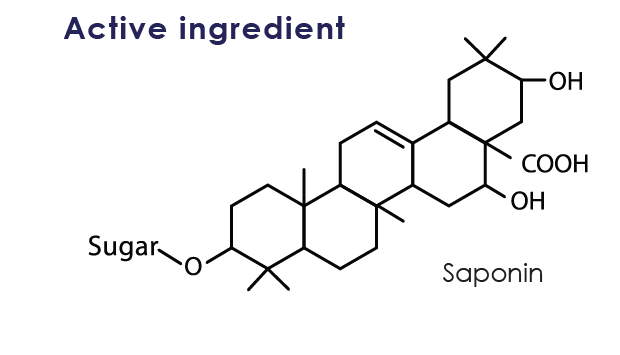
Chemical Constituent24: Shikakai contains a variety of phytochemicals, including tannins, saponins, flavonoids, vitamins, minerals, as well as alkaloids, phenolic compounds, and terpenoids.
Structure:
Fig.3: Saponin²
|
Mechanism of Action25: Antifungal activity: Shikakai contains bioactive compounds that exhibit antifungal effects, particularly against Malassezia species responsible for dandruff. |
Scalp cleansing: The natural saponins in shikakai act as effective surfactants, helping to remove excess sebum and impurities from the scalp
Use24: Soothing properties: Its anti-inflammatory nature may help relieve scalp irritation, itching, and discomfort associated with dandruff.
4. Bhirngraj:
Common Name27,28: Bhringraj
Biological source27,28: The biological source is the plant Eclipta albaleaves
Family26: Asteraceae
Chemical Constituents27: flavonoids- The primary flavonoids found include apigenin, luteolin, luteolin-7-glucoside, and orobol. alkaloids-The primary alkaloids found in E. alba leaves include (20S) -(25S)-22,26-imino-cholesta-5,22(N)-dien-3β-ol (verazine, 3). Phenolic acid- E. alba contains phenolic acids such as protocatechuic acid and 4-hydroxybenzoic acid. Its main sesquiterpene lactones include 5-hydroxymethyl-(2,2’:5’,2”)-terthienyltiglate, 5-hydroxymethyl-(2,2’:5’,2”)-terthienylagelate.
Structure:
Fig.4: Apegenin²
Mechanism of Action27: Hair Growth Promotion: topical application of the plant's extract leads to prominent follicular hypertrophy and an increase in the number of follicular keratinocytes in the basal epidermal and matrix cells, which supports hair growth.
Uses27: Hair Care: It is known as the "King of Hair" and is used to enhance hair growth, strength, and blackening. It also treats hair problems like hair fall, dandruff, premature greying, and baldne.
5. Tulsi:
Common Name30: Tulsi, Holy Basil, or Sacred Basil.
Biological Source30,31: Ocimum sanctum L., which is a member of the Lamiaceae family.
Family30: Lamiaceae
Chemical Constituents30: Leaf Volatile Oil: Contains eugenol, euginal (eugenic acid), carvacrol, linalool, caryophyllene, and methyl carvicol (estragol). Seeds: The volatile oil of the seed contains fatty acids and sitosterol, while the seed mucilage has sugars and anthocyans. Leaves and Stems: Contain saponins, flavonoids, triterpenoids, and tannins. Phenolic Compounds: Rosmarinic acid, apigenin, cirsimaritin, isothymusin, and isothymonin are present and exhibit antioxidant and anti-inflammatory properties.
Structure:
Fig.5: Carvacrol32
Mechanism of Action30: Anti-inflammatory: Rosmarinic acid, apigenin, and especially eugenol are responsible for its anti-inflammatory properties. Adaptogenic: Eugenol, caryoph yllene, ursolic acid, and oleanolic acid help control mood swings, promote mental clarity, and reduce corticosterone levels, which are the primary cause of stress. Antibacterial: Carvacrol, terpene, and Sesquiterpene B-caryophyllene are antibacterial agents that help keep the body safe from illness-causing bacteria.
Uses30: Stress and Headaches: Regarded as an "adaptogen" or anti-stress agent, its leaves can be chewed twice daily to help prevent stress. A decoction of the leaves or a paste made with sandalwood can be applied to the forehead for headache relief.
6. Reetha:
Common Name33: Soapnut, Soapberry, and Washnut.
Biological Source33: Sapindus Mukorossi, which is a medicinal plant often found in the hilly regions of India and in tropical and subtropical regions of Asia.
Family33: Sapindaceae
Chemical Constituent34: Friut: Saponins- 10–11.5%, sugars and mucus -10%, Seeds contain trifolioside A, sapindiside C, D, E, glucopyranoside of stigmasterol, kaempferol, quercetin, B-sitosterol, hederagenin, proteins, carbohydrates and starch.
Structure:
Fig.6: β-sitosterol³
Mechanism of Action33: The surfactant properties of this plant are highly desirable because they enable it to serve as a natural, plant-based substitute for synthetic surfactants in a wide range of commercial and industrial applications. Reetha (in the form of powder or organicextracts) is a well-established, primary ingredient in many herbal and natural products, including shampoos, bath soaps, hair dyes, body-care lotions, and fabric washing detergents. The biosurfactant extracts obtained from Sapindus can be effectively substituted for synthetic surfactants in commercial formulations like shampoos, soaps, and other cosmetic products.
Uses33: Shampoos and detergents. The plant's biosurfactant extracts are used in products such as shampoos, soaps, and other cosmetics. Reetha is a key ingredient in herbal products like bath soaps, hair dyes, shampoos, and body-care lotions. Additionally, the fruit extract has been shown to have antifertility, antihyperlipidemic (cholesterol-lowering), and antimicrobial properties.
7. Hibiscus
Common Name36: Hibiscus
Biological Source36: The biological source of hibiscus used for hair care is typically Hibiscus rosa-sinensis, a flowering plant belonging to the Malvaceae family.
Family36: Malvaceae
Chemical Constituents36:
PhenolsAlkaloids, Tannins, flavonoids, saponins, mucilage, vitamins (like vitamins A and C), and amino acids, which are beneficial for hair health.
Structure:
Fig.7: Vitamin C³
MechanismofAction36: FollicleStimulation: It extends the anagen, or growth, phase of the hair cycle and stimulates the proliferation of hair-forming cells (keratinocytes and dermal papilla cells).Enzyme Inhibition: Hibiscus contains compounds that can inhibit the 5-alpha-reductase enzyme, which is associated with hair loss, particularly in cases of androgenetic alopecia.Antioxidant and Anti-inflammatory Effects: Its antioxidant and anti-inflammatory properties protect hair follicles from damage caused by oxidative stress and inflammation, creating a healthier environment for hair to grow.Improved Blood Circulation: The extracts from the flowers and leaves can increase microcirculation in the scalp, ensuring that hair follicles receive essential nutrients and oxygen.Keratin Production: The amino acids in hibiscus act as building blocks for keratin, the protein that makes up hair. This helps strengthen hair strands, reduce breakage, and promote thicker hair.
Uses36: Hibiscus has multiple beneficial effects on hair health. Its rich antioxidant content, including flavonoids and polyphenols like quercetin and anthocyanins, helps protect hair follicles from damage and inflammation caused by free radicals. This can prevent stress-related aging and hair loss. Additionally, the plant's phytochemicals, such as saponins, flavonoids, and tannins, have antimicrobial properties that can fight against dandruff-causing microorganisms, promoting a healthy scalp. Hibiscus also acts as a natural conditioner due to its mucilage content. When used in hair products, it can hydrate hair, making it softer, shinier, and improving its texture and moisture retention.
8. Neem:
Common Name38: Neem
Biological Source38: The biological source is the tree Azadirachta indica A. Juss.
Family38: Meliaceae
Chemical Constituent38: Azadirachtin A-G (found in leaves) Salannin, nimbin, gedunin, nimbidin, and nimbolide. Flavonoids, rutin, quercetin, carotenoids, and tannins. Neem kernels are noted to have an oil content of 30-50%
Structure:
Fig.8: Nimbidin³
Mechanism of Action38: Antifungal: Some triterpenoids from Neem oil show a synergistic effect against fungi when combined, even if they have little activity individually.Antimicrobial: Some compounds like nimbolide and nimbidin exhibit antibacterial activity.
Psoriasis: Nimbidin, a secondary metabolite, may inhibit prostaglandin synthetase to help treat psoriasis
Uses38: It is used for a variety of cosmetic claims, including anti-acne treatment, skin-whitening, anti-dandruff, and anti-aging effects.
9. Fenugreek:
Common Name40: Fenugreek
Biological Source40: Fenugreek consists of the dried, ripe seeds of Trigonella foenum-graecum
Chemical Constituents41: Diosgenin: A steroidal sapogenin that is a key component for producing over 60% of all pharmaceutical steroids. Other related sapogenins found in the seeds include yamogenin, gitogenin, tigogenin, and neotigogens. Saponins: 4.8%. Alkaloids: trigonelline, gentianine, and carpaine. Fiber: The seeds are a rich source of fiber and protein. The crude fiber is composed of cellulose, hemicellulose (like pectin), and lignin.
Family40: Fabaceae
Structure:
Fig.9: Diosgenin2
Mechanism of Action40: Fenugreek is effective against hair loss and baldness because of its nutrient and protein content. It deeply nourishes both the hair and the scalp.
Uses40: It helps fight lice and dandruff. It strengthens and softens dry, damaged, and brittle hair and invigoratehair growth. The seeds are used as a cosmetic ingredient in face packs and hair masks. Fenugreek can be combined with other ingredients like rosemary, coconut oil, amla, hibiscus, and egg for hair care.
10. Brahmi:
Common Name43: Thyme-leaved gratiola, Indian pennywort, and water hyssop.
Biological Source43: The biological source of Brahmi is the plant Bacopamonnieri Linn.
Family43: Scrophulariaceae
Chemical Constituent42: Brahmi are saponins, specifically bacosides. Other compounds include alkaloids, flavonoids, phytosterols, and several other phytochemicals.
Structure:
Fig.10: Bacoside
Mechanism of Action46: The alcoholic extracts or whole drug formulations of Emblica officinalis, Bacopa monnieri, and Cyperus rotundus demonstrated superior hair growth activity compared to other preparations, evidenced by enlarged follicle size and prolonged anagen phase.
Uses46: Brahmi offers several benefits for hair and scalp health, including treating dandruff and related scalp issues, preventing hair loss and split ends, and encouraging hair growth.
CONCLUSION:
Herbal powder shampoos represent a promising and evolving sector of hair care. These products, which are based on traditional knowledge but are now supported by modern science, provide an attractive alternative to traditional liquid shampoos. The combination of plant-based components efficiently cleanses and conditions hair while also treating common scalp issues and having a low environmental impact. Due to rising consumer desire for natural, sustainable, and customized goods, herbal powder shampoos are in a great position to meet future demand since they are long-lasting. They eventually link ancient knowledge with cutting-edge cosmetic research, providing a comprehensive solution for a better hair care regimen and a more environmentally friendly world.
CONFLICT OF INTEREST:
The writers have no conflicts of interest regarding this investigation.
ACKNOWLEDGEMENT:
The authors express their sincere thanks to Dean, Teaching and non-teaching faculty of Dr. Subhash University, Junagadh, Gujarat, India for providing guidance and support to this review work.
REFERENCE:
1. Pandey T, Singh V, Singh D, Sahu P, Sahu GK, Sharma H. Plant-based powders in dry shampoo: a sustainable solution for hair cleansing. Acta Sci Pharm Sci. 2025 Jan; 9(1): 96-100.
2. Thakur A, Pandit V, Ashawat MS. A review on herbal shampoo. World J Pharm Res. 2020; 9(8):1132-7. doi:10.20959/wjpr20208-18268.
3. P Naga Haritha, PabbaSupraja, ShaistaSamreen, Hrudayanjali, Munawar Qureshi, P Sandya, T Swetha. A Review on Polyherbal Shampoo Powder. Human Journals Review Article. 2021 May; 21(2): 346-63.
4. Nipurte DS, Datir MB, Fulsundar AS. A review on formulation and evaluation of herbal shampoo. World Journal of Pharmaceutical Research. 2022; 11(3): 412-418. Doi:10.20959/wjpr20223-23171
5. Satyanarayana T, Nirmalakumari D, Sai roshiniCh, Dileep K, Sai kiran K, Akshitha M, Sucharitha V, Sagarika M. Formulation and Evaluation of Poly Herbal Shampoo Powder. International Journal of Pharmacy and Pharmaceutical Research. 2022 Jun; 24(3): 107–25
6. Venkatesan Natarajan, Dharshini Jaishankar, Lohitha Sugumar, Nisha Suresh, Reka Thiruvengadam. Comprehensive Review on Formulation and Evaluation of Herbal Shampoo. Journal of Neonatal Surgery. 2025; 14 (19s): 704-712.
7. Gupta A, Sharma V, Moharana BP, Kumar A, Ghosh T, Bhowmick A, et al. An in-depth review on phytochemistry and pharmacological significance of phyllanthusemblicalinn. Redve - Revistaelectrónica de Veterinaria. 2024; 25(2).
8. Acharya S. shikakai (Acacia concinna) in dermatology: potential uses and therapeutic benefits for skin disorders. Int J Progressive Res Eng Manage Sci. 2024; 4(6): 1221–7.
9. Sabale S, Rasve V, Garje S, Sayyed G. The botanical jewel: a comprehensive review of Lawsoniainermis and its diverse applications. Int J Progressive Res Eng Manage Sci. 2024; 4(4): 813–8.
10. Al-Snafi AE. A review on Lawsoniainermis: A potential medicinal plant. International journal of current pharmaceutical research. 2019; 11(5):1-3.
11. Chaudhari LY, Chaudhari SP, Chavan GM. A brief review on Tulsi: a holy plant with high medicinal values and therapeutic uses. International Journal f Research Ayurveda and Pharmacy. 2022; 13(3).
12. Pande AB, Lal PI, Chaudhary PH, Ruikar DB. A comprehensive review on Sapindustrifoliatus Linn. Int J Res Anal Rev. 2023; 10(2).
13. An update review on Hibiscus rosa sinensis phytochemistry and medicinal uses, Asmaa Missoum. Journal of Ayurvedic and Herbal Medicine 2018; 4(3): 135-146
14. Gautam P, Mittal P. A Review on Traditional Plant Azadirachta indica: Natural Source for Disease Curability and Health Promotion Journal of Pharmaceutical Research International. 2021; 33(56A): 1–7.
15. Chaudhary S, Chaudhary PS, Chikara SK, Sharma MC, Iriti M. Review on fenugreek (Trigonellafoenum-graecum L.) and its important secondary metabolite diosgenin. Notulae Botanicae Horti Agrobotanici Cluj-Napoca 2018; 46(1): 22-31. doi:10.15835/nbha46110996.
16. Ganguly D, Rahaman A, Roy SK. A comprehensive review of Ayurvedic medicinal plant Haritaki (Terminalia chebula Retz.) and its pharmacological actions. International Ayurvedic Medical Journal. 2022 Nov. doi:10.46607/iamj1210112022.
17. Menon S, Takalkar T, Mulye N, Khandagale S. An Ayurvedic literature review on Brahmi (Bacopamonnieri L). Afr J Biol Sci. 2024; 6(9): 2421-32. doi:10.33472/AFJBS.6.9.2024.2421-2432.
18. Swetha Dasaroju, Krishna Mohan Gottumukkala. "Current Trends in the Research of Emblica officinalis (Amla): A Pharmacological Perspective." International Journal of Pharmaceutical Sciences Review and Research, vol. 24, no. 2, Jan-Feb 2014, pp. 150-159.
19. Vaja PN, Popaniya HS, Tank CJ, Tank PV, Parmar KH, Borkhataria CH. A basic review on herbal plants for sunscreen preparation. Res J Top Cosmet Sci. 2024; 15(2): doi:10.52711/2321-5844.2024.00020
20. https://www.researchgate.net/figure/Chemical-structure-of-emblicanin-A_fig8_351815895
21. Vairagade VS, Morkhade AN, Keshave AK, Umate SS. Formulation and evaluation of herbal hair dye using henna. World Journal of Pharmaceutical Research. 2024; 13(11): 882-923.
22. Al-Snafi AE. A review on Lawsoniainermis: a potential medicinal plant. International Journal of Current Pharmaceutical Research. 2019; 11(5): 1-13.
23. https://www.researchgate.net/profile/GoutamBar/publication/366182180/figure/fig2/AS:11431281109005861@1671702996063/Chemical-structure-of-tannin.png
24. Wattamwar SS, Kulkarni SS, Pawar CV, Saindane SS, Ankush TD. Pure Essence: Shikakai Shampoo Tablets. International Journal of Creatative Research Thoughts. 2024 Jul;12(7)
25. Pailwan JS, Pore AV, Bais SK. Review on: cosmetic importance of Shikakai. International Journal of Pharmacy and Herbal Technology. 2024; 2(4)
26. https://www.snpthai.com/wp-content/uploads/2021/09/Acacia-Concinna-Extract-Powder.png
27. Kumari I, Kaurav H, Chaudhary G. Eclipta alba (Bhringraj): A promising hepatoprotective and hair growth stimulating herb. Asian Journal of Pharmaceutical and Clinical Research. 2021; 14(7): 16-23.
28. Vaja PN, Popaniya HS, Tank CJ, Borkhataria CH, Vachhani AN, Pithiya DR. The botanical breakthrough: Herbal approaches to reversing alopecia. Asian Journal of Pharmaceutical Research. 2024; 14(4): [page numbers if available]. doi:10.52711/2231-5691.2024.00063.
29. https://upload.wikimedia.org/wikipedia/commons/thumb/e/e6/Apigenin.svg/1200px-Apigenin.svg.png
30. Sethi L, Bhadra P. A review paper on Tulsi plant (Ocimum sanctum L.). Indian Journal of Natural Science. 2020;10(60)
31. Vaja PN, Borkhataria CH, Popaniya HS, Tank CJ, Pithiya DR, Vachhani AN. A systematic review on medicinal plant species to treat pharyngitis. Asian Journalof PharmacyTechnology. 2024; 14(3). doi:10.52711/2231-5713.2024.00035
32. https://encryptedtbn0.gstatic.com/images?q=tbn:ANd9GcQoIsFLUPRinwa0X43iJ54od6DKHfnbMydTse5Kqe1N1oYBe2-DeFHiB0NqZkgXmjkFo8HFhw
33. Sonawane SM, Sonawane H. A review of recent and current research studies on the biological and pharmacological activities of Sapindus mukorossi. Int J Interdisciplinary Res Innov. 2015 Oct–Dec; 3(4): 85–95.
34. Pande AB, Lal PI, Chaudhary PH, Ruikar DB. A compransive review on sapindustrifoliatuslinn. International Journal of Research and Analytical Reviews (IJRAR). 2023 Apr;10(2).
35. Kumar R, Bhatt SC, Pandey V, Rana P, Rawat S. hibiscus flower extract as a natural hair growth stimulant: A comprehensive review of mechanism and application. International Journal of Research Publication Reviews. 2025 Jan; 6(1): 45416.
36. https://upload.wikimedia.org/wikipedia/commons/e/e7/L-Ascorbic_acid.svg
37. Baby AR, Freire TB, Marques GA, Rijo P, Lima FV, de Carvalho JCM, Rojas J, Magalhães WV, Velasco MVR, Morocho-Jácome AL. Azadirachta indica (Neem) as a Potential Natural Active for Dermocosmetic and Topical Products: A Narrative Review. Cosmetics. 2022; 9(3): 58. doi: 10.3390/cosmetics9030058.
38. https://pubchem.ncbi.nlm.nih.gov/image/imgsrv.fcgi?cid=169088andt=l
39. https://encryptedtbn0.gstatic.com/images?q=tbn:ANd9GcQAOEM1TPiBHO2z4wg2oYY3jgwovNZjcYBsTQands
40. Yadav P, Wasiullah M, Rajak K, Yadav G. A review article role on cosmeceutical of hair growth fenugreek and onion oil. World Journal of Pharmaceutical Research. 2023; 12(1): 791-799.
41. Kumawat NK, Sharma PL. Methi a wonderful herb and its therapeutic uses: A pharmacognostic perspective. World Journal of Pharmaceutical Research. 2016; 5(3): 466-474.
42. 3-s2.0-B9780123864543010162-u01016-01-9780123864543.jpg (338×222)
43. Meena A, Rankawat S, Jitendra, Kaushal K, Gurjar H. Brahmi- “the herb of enlighnment”. World Journal of Pharmaceutical Research. 2022; 11(13): 793-802. doi:10.20959/wjpr202213-25666.
44. https://pubchem.ncbi.nlm.nih.gov/image/imgsrv.fcgi?cid=92043183andt=l
45. Tamboli FA, Rangari VD, Tarlekar SD, Jadhav RD, Alaskar KM, Desai VV, et al. Brahmi (Bacopamonnieri): an ayurvedic herb in the management of various diseases. J Postharvest Technol. 2022; 10(4): 59-74.
46. Mondal S, Bhar K, Mondal P, Panigrahi N, Sahoo SK, Swetha P, Chakraborty S, Teja NY, Parveen N. In Quest of the Mysterious Holistic Vedic Herb Bacopamonnieri (L.) Pennell. Pharmacognosy Research. 2023; 15(3): 410-54. doi: 10.5530/pres.15.3.045.
|
Received on 04.11.2025 Revised on 15.01.2026 Accepted on 19.02.2026 Published on 04.07.2026 Available online from July 18, 2026 Asian J. Pharm. Tech. 2026; 16(3):259-265. DOI: 10.52711/2231-5713.2026.00037 ©Asian Pharma Press All Right Reserved
|
|
|
This work is licensed under a Creative Commons Attribution-NonCommercial-ShareAlike 4.0 International License. Creative Commons License. |
|